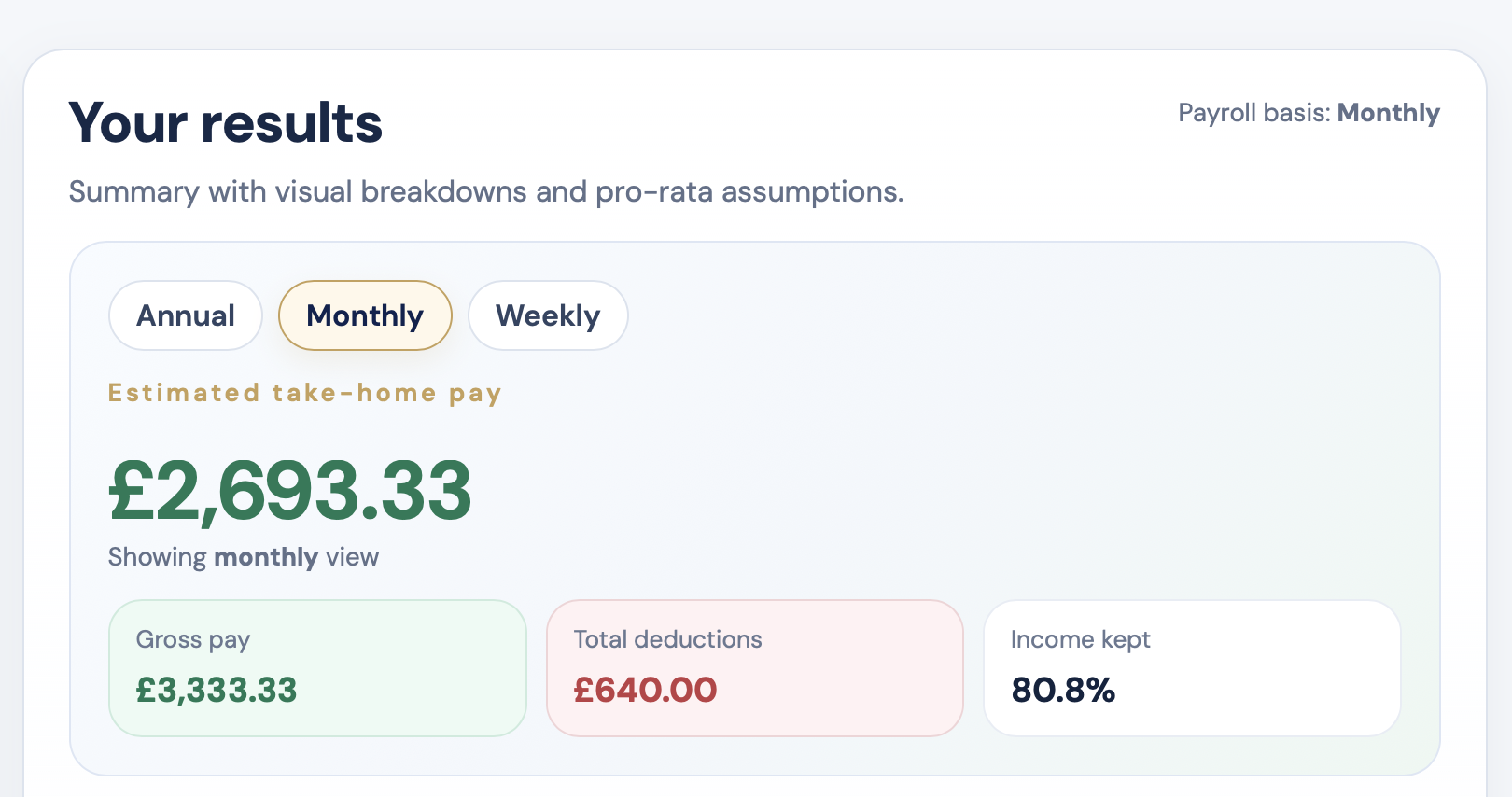
If you earn £40,000 a year, your monthly take-home pay in the UK in 2026 is roughly £2,693 after Income Tax and employee National Insurance, assuming you are on a standard tax code, have no pension salary sacrifice, and do not live in Scotland.
This means:
- Annual take-home pay: £32,320.00
- Monthly take-home pay: £2,693.33
- Weekly take-home pay: ~£622
This guide explains exactly how your £40,000 salary is taxed, how much you take home each month, and what factors can change your net pay.
This calculation is based on the 2026/27 UK tax year using standard HMRC rates.
If you want to test your own payslip with pension, bonus or student loan deductions, use our take home pay calculator for a personalised result.
£40,000 take-home pay UK (2026 summary)
- Gross salary: £40,000
- Income Tax: £5,486.04
- National Insurance: £2,193.96
- Net annual pay: £32,320.00
- Net monthly pay: £2,693.33
- Net weekly pay: ~£622
£40,000 salary after tax in the UK: monthly and annual breakdown
| Item | Annual | Monthly |
|---|---|---|
| Gross salary | £40,000.00 | £3,333.33 |
| Income Tax | £5,486.04 | £457.17 |
| Employee National Insurance | £2,193.96 | £182.83 |
| Take-home pay | £32,320.00 | £2,693.33 |
So for most employees in England, Wales and Northern Ireland, £40k after tax is about £2.7k per month.
£40,000 weekly take-home pay UK
If you earn £40,000 per year, your weekly take-home pay is approximately £622 after tax and National Insurance.
This is useful for:
- Weekly budgeting and spending tracking
- Comparing job offers or contract rates
- Understanding real disposable income
How the tax is worked out
For the 2026 to 2027 tax year, the standard Personal Allowance is £12,570. The basic rate of Income Tax is 20% up to £50,270, and employee National Insurance is generally charged at 8% between the primary threshold and the upper earnings limit.
On a £40,000 salary:
- The first £12,570 is tax-free
- The remaining £27,430 is taxed at 20% = £5,486.04
- Employee National Insurance is charged on earnings above £12,570, giving a bill of about £2,193.96
Because £40,000 is below the £50,270 higher-rate threshold, you do not normally pay 40% Income Tax on this salary level in the rest of the UK.
What is £40k per month before and after tax?
Before deductions, a £40,000 salary is £3,333.33 per month.
After Income Tax and National Insurance, that falls to around £2,693.33 per month.
- Gross monthly pay: £3,333.33
- Total monthly tax and NI: £640
- Net monthly pay: £2,693.33
£40k salary after tax with student loan deductions
If you still repay a student loan, your real monthly take-home will be lower. The exact amount depends on your repayment plan.
| Scenario | Annual take-home | Monthly take-home |
|---|---|---|
| No student loan | £32,320.00 | £2,693.33 |
| Plan 1 | £31,141.00 | £2,595.08 |
| Plan 2 | £31,364.68 | £2,613.72 |
| Plan 5 | £30,970.00 | £2,580.83 |
| Postgraduate Loan only | £31,180.00 | £2,598.33 |
At this salary, a Plan 2 borrower loses roughly £80 per month, while a Plan 5 borrower loses about £112.50 per month.
You can estimate your repayments using our student loan calculator.
£40,000 vs £50,000 salary UK
If your salary increases from £40,000 to £50,000, you keep a large portion of the increase because both salaries fall mostly within the basic tax band.
You can compare salary levels using our salary comparison calculator.
Monthly budgeting on a £40,000 salary
With a take-home of around £2,600 to £2,700 per month, many people can cover:
- Housing costs (rent or mortgage)
- Bills and utilities
- Transport and commuting
- Food and household spending
- Savings and discretionary spending
Your actual affordability depends heavily on your location and fixed expenses.
What can reduce your £40k take-home pay further?
Your actual payslip may be lower if you have:
- Workplace pension contributions
- Salary sacrifice arrangements
- Student loan deductions
- Bonus payments taxed through PAYE
- Scottish Income Tax rates
To model your exact situation, use our take home pay calculator.
Is £40,000 a good salary in the UK?
In many parts of the UK, £40k is considered a solid full-time salary.
- Comfortable in many regions
- Can allow saving and investing
- May feel tighter in high-cost cities
What matters most is your disposable income after essential costs.
What should you do next?
If you are earning £40,000, you may want to:
- Review pension contributions to optimise tax efficiency
- Estimate student loan repayments
- Compare your salary with nearby levels like £35k or £50k
Useful tools:
Summary
A £40,000 salary after tax in the UK works out to about £32,320.00per year or £2,693.33 per month in 2026 under standard tax conditions.
Your real take-home may be closer to £2,576 to £2,610 per month if student loan deductions apply. Understanding your net income is key to budgeting and financial planning.