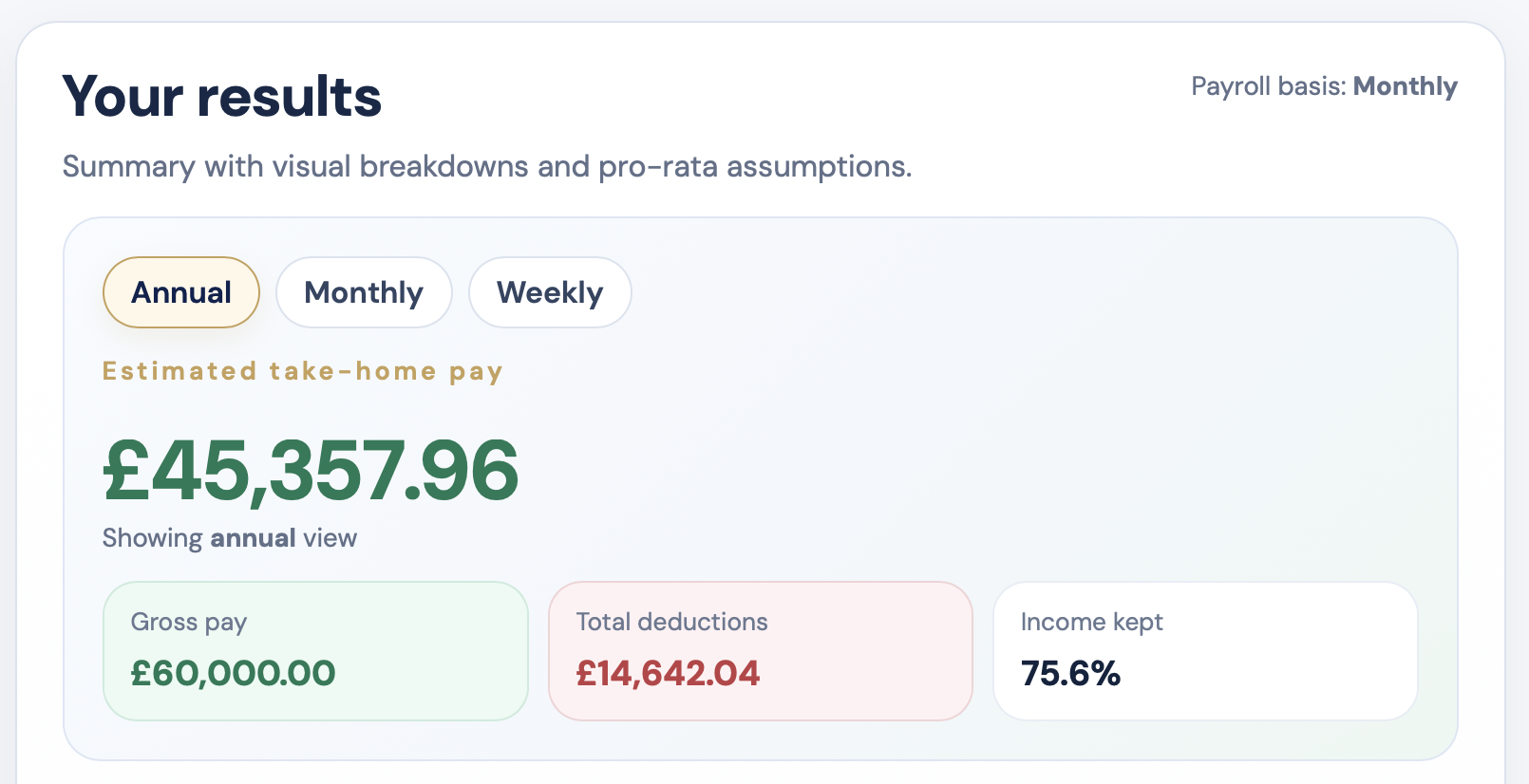
If you earn £60,000 a year, your monthly take-home pay in the UK in 2026 is roughly £3,779.83 after Income Tax and employee National Insurance, assuming you are on a standard tax code, have no pension salary sacrifice, and do not live in Scotland.
This means:
- Annual take-home pay: £45,357.96
- Monthly take-home pay: £3,779.83
- Weekly take-home pay: ~£873
This guide explains exactly how your £60,000 salary is taxed, how much you take home each month, and what factors can change your net pay.
This calculation is based on the 2026/27 UK tax year using standard HMRC rates.
If you want to test your own payslip with pension, bonus or student loan deductions, use our take home pay calculator for a personalised result.
£60,000 take-home pay UK (2026 summary)
- Gross salary: £60,000
- 20% Income Tax: £7,539.96
- 40% Income Tax: £3,891.96
- National Insurance: £3,210.00
- Net annual pay: £45,357.96
- Net monthly pay: £3,779.83
- Net weekly pay: ~£873
£60,000 salary after tax in the UK: monthly and annual breakdown
| Item | Annual | Monthly |
|---|---|---|
| Gross salary | £60,000.00 | £5,000.00 |
| 20% Income Tax | £7,539.96 | £628.33 |
| 40% Income Tax | £3,891.96 | £324.33 |
| Employee National Insurance | £3,210.00 | £267.50 |
| Take-home pay | £45,357.96 | £3,779.83 |
So for most employees in England, Wales and Northern Ireland, £60k after tax is about £3.8k per month.
£60,000 weekly take-home pay UK
If you earn £60,000 per year, your weekly take-home pay is approximately £873 after tax and National Insurance.
This is useful for:
- Weekly budgeting and spending tracking
- Comparing salaried and contract work
- Understanding your real disposable income
How the tax is worked out
For the 2026 to 2027 tax year, the standard Personal Allowance is £12,570. The basic rate of Income Tax is 20% up to £50,270, and income above that threshold is generally taxed at 40% for most UK taxpayers outside Scotland. Employee National Insurance is generally charged at 8% and then 2% above the upper earnings limit.
On a £60,000 salary:
- The first £12,570 is tax-free
- A portion of your taxable income is taxed at 20% = £7,539.96
- The part above the higher-rate threshold is taxed at 40% = £3,891.96
- Employee National Insurance comes to about £3,210.00
Unlike salaries below the higher-rate threshold, a £60,000 salary does push some of your income into the 40% tax band, which means each extra £1 above that point is taxed more heavily.
What is £60k per month before and after tax?
Before deductions, a £60,000 salary is £5,000.00 per month.
After Income Tax and National Insurance, that falls to around £3,779.83 per month.
- Gross monthly pay: £5,000.00
- Total monthly tax and NI: £1,220.16
- Net monthly pay: £3,779.83
How to manage the 40% tax band on £60,000
At £60,000, part of your salary now falls into the higher-rate tax band. That does not mean all of your salary is taxed at 40%, but it does mean the slice above the higher-rate threshold is taxed more heavily.
For many people, this is the point where tax planning starts to matter more. A few sensible decisions can improve how much value you keep from pay rises, bonuses and extra earnings.
Common ways to manage a salary in the 40% band include:
- Increasing workplace pension contributions
- Using salary sacrifice if your employer offers it
- Checking how bonuses are being paid and taxed
- Reviewing student loan deductions alongside pension choices
- Comparing whether extra gross pay is really worth it after deductions
For example, pension contributions can be especially useful at this salary level because they may reduce the amount of income exposed to higher-rate tax. That can improve long-term wealth building while also softening the immediate tax hit on extra earnings.
If your employer offers salary sacrifice, it may be even more efficient because it can reduce both taxable pay and National Insurance in some cases. This is often one of the simplest ways to improve tax efficiency without needing complex planning.
It is also worth paying attention to bonuses. A bonus may look generous in gross terms, but once 40% tax, National Insurance and student loan deductions are applied, the amount you actually receive can be much lower than expected.
If you want to see how changing pension contributions could affect your monthly net pay, use our take home pay calculator and compare different deduction settings.
Can a SIPP help if you earn £60,000?
Yes, a SIPP (Self-Invested Personal Pension) can be an option if you earn £60,000 and want more control over your pension contributions.
At this salary, part of your income falls into the 40% tax band. Making extra pension contributions through a SIPP may help reduce how much of your income is exposed to higher-rate tax, while also boosting your retirement savings.
A SIPP may be useful if you want to:
- make extra pension contributions outside your workplace pension
- invest in a wider range of funds or assets
- top up your pension after a pay rise or bonus
- claim higher-rate pension tax relief if eligible
Many SIPPs use relief at source, where the provider adds basic-rate tax relief automatically. If you are a higher-rate taxpayer, you may need to claim the extra relief from HMRC separately.
You still need to stay within pension tax relief limits and the annual allowance. If you want to model how pension contributions could change your monthly net pay, use our take home pay calculator.
£60k salary after tax with student loan deductions
If you still repay a student loan, your real monthly take-home will be lower. The tax and National Insurance figures do not change here, but your student loan deductions reduce the amount you actually receive.
| Scenario | Annual take-home | Monthly take-home |
|---|---|---|
| No student loan | £45,357.96 | £3,779.83 |
| Plan 1 | £42,378.96 | £3,531.58 |
| Plan 2 | £42,602.64 | £3,550.22 |
| Plan 5 | £42,207.96 | £3,517.33 |
| Postgraduate Loan only | £43,017.96 | £3,584.83 |
The matching annual and monthly student loan deductions are:
- Plan 1: £2,979.00 per year or £248.25 per month
- Plan 2: £2,755.32 per year or £229.61 per month
- Plan 5: £3,150.00 per year or £262.50 per month
- Postgraduate Loan only: £2,340.00 per year or £195.00 per month
At this salary, a Plan 2 borrower loses roughly £229.61 per month, while a Plan 5 borrower loses about £262.50 per month.
You can estimate your repayments using our student loan calculator.
£60,000 vs £50,000 salary UK
If your salary increases from £50,000 to £60,000, the extra income is less efficient than a move within the basic-rate band because some of it falls into the 40% tax bracket.
You can compare salary levels using our salary comparison calculator.
Monthly budgeting on a £60,000 salary
With a take-home of around £3,500 to £3,780 per month depending on deductions, many people can usually cover:
- Housing costs such as rent or mortgage payments
- Bills and utilities
- Transport and commuting
- Savings, investing and pension top-ups
- Discretionary spending and lifestyle costs
However, affordability still depends heavily on your location, housing costs, childcare and other fixed expenses. A £60k salary can feel strong in many parts of the UK, but much tighter in high-cost areas.
What can reduce your £60k take-home pay further?
Your actual payslip may be lower if you have:
- Workplace pension contributions
- Salary sacrifice arrangements
- Student loan deductions
- Bonus payments taxed through PAYE
- Scottish Income Tax rates
To model your exact situation, use our take home pay calculator.
Is £60,000 a good salary in the UK?
In many parts of the UK, £60k is considered a strong salary and comfortably above average full-time earnings.
- Strong income in many regions
- Usually allows saving and investing
- Still reduced noticeably by higher-rate tax and student loan deductions
What matters most is not just the headline salary, but your disposable income after tax, debt repayments, pension contributions and essential monthly costs.
What should you do next?
If you are earning £60,000, you may want to:
- Check whether pension contributions could improve tax efficiency
- Estimate the impact of student loan deductions on your monthly cash flow
- Compare your pay with nearby salary levels such as £50k or £70k
Useful tools:
Summary
A £60,000 salary after tax in the UK works out to about £45,357.96 per year or £3,779.83 per month in 2026 under the figures used here.
Your real take-home may be closer to £3,517 to £3,585 per month if student loan deductions apply. Once you are in the 40% tax band, it becomes more important to think about pension contributions, salary sacrifice and how efficiently you handle extra income.