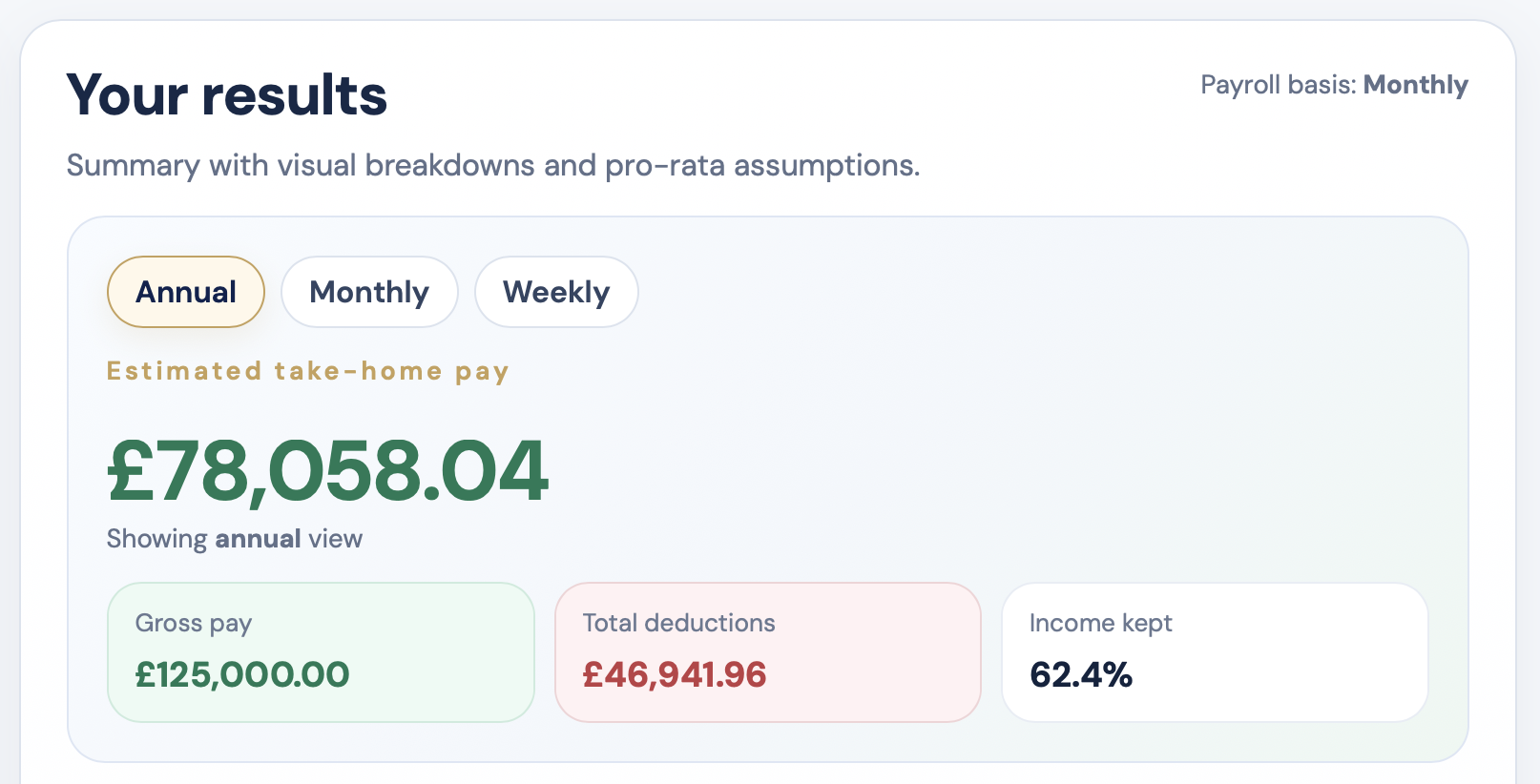
If you earn £125,000 a year, your monthly take-home pay in the UK in 2026 is roughly £6,504.84 after Income Tax and employee National Insurance, assuming you are on a standard tax code, have no pension salary sacrifice, and do not live in Scotland.
This means:
- Annual take-home pay: £78,058.04
- Monthly take-home pay: £6,504.84
- Weekly take-home pay: ~£1,501
This guide explains exactly how your £125,000 salary is taxed, how much you take home each month, and what factors can change your net pay.
This calculation is based on the 2026/27 UK tax year using the figures provided here.
If you want to test your own payslip with pension, bonus or student loan deductions, use our take home pay calculator for a personalised result.
£125,000 take-home pay UK (2026 summary)
- Gross salary: £125,000
- 20% Income Tax: £7,539.96
- 40% Income Tax: £34,892.04
- National Insurance: £4,509.96
- Net annual pay: £78,058.04
- Net monthly pay: £6,504.84
- Net weekly pay: ~£1,501
£125,000 salary after tax in the UK: monthly and annual breakdown
| Item | Annual | Monthly |
|---|---|---|
| Gross salary | £125,000.00 | £10,416.67 |
| 20% Income Tax | £7,539.96 | £628.33 |
| 40% Income Tax | £34,892.04 | £2,907.67 |
| Employee National Insurance | £4,509.96 | £375.83 |
| Take-home pay | £78,058.04 | £6,504.84 |
So for most employees in England, Wales and Northern Ireland, £125k after tax is about £6.5k per month.
£125,000 weekly take-home pay UK
If you earn £125,000 per year, your weekly take-home pay is approximately £1,501 after tax and National Insurance.
This is useful for:
- High-level budgeting and financial planning
- Comparing senior roles or contract opportunities
- Understanding real disposable income after heavy taxation
How the tax is worked out
For the 2026 to 2027 tax year, the standard Personal Allowance is £12,570, but at £125,000 it is effectively fully removed due to the Personal Allowance taper.
On a £125,000 salary:
- Your Personal Allowance is reduced to near £0
- A portion is taxed at 20% = £7,539.96
- A large portion is taxed at 40% = £34,892.04
- Employee National Insurance totals about £4,509.96
At this level, you are fully exposed to higher-rate tax and have lost the benefit of the tax-free Personal Allowance entirely.
What is £125k per month before and after tax?
Before deductions, a £125,000 salary is £10,416.67 per month.
After Income Tax and National Insurance, that falls to around £6,504.84 per month.
- Gross monthly pay: £10,416.67
- Total monthly tax and NI: £3,911.83
- Net monthly pay: £6,504.84
The key consideration at £125,000: zero Personal Allowance
By the time you reach £125,000, your Personal Allowance has been fully removed due to the taper between £100,000 and £125,140.
This means:
- You no longer receive the £12,570 tax-free allowance
- Your entire income is effectively taxable
- You have already passed through the highly inefficient £100k–£125k range
This range is often described as having an effective 60% tax rate, because you are paying 40% tax while also losing your Personal Allowance.
At £125,000, that process is complete — but it means a significant portion of your income has been taxed very heavily on the way up.
How to manage tax at £125,000
At this salary, tax planning becomes essential rather than optional. The goal is to manage how much income is exposed to higher-rate tax and whether you can regain some Personal Allowance efficiency.
Common strategies people consider include:
- Increasing pension contributions
- Using salary sacrifice where available
- Managing bonus payments carefully
- Reducing adjusted net income below £125k or even £100k where possible
- Reviewing total deductions including student loans
Even small adjustments in taxable income can have a large effect in this range, especially if they move you back into a more efficient tax band.
Can a SIPP help if you earn £125,000?
Yes, a SIPP (Self-Invested Personal Pension) can be particularly powerful at this salary level.
At £125,000, a SIPP may help you:
- Reduce adjusted net income and potentially restore some Personal Allowance
- Avoid or reduce exposure to the effective 60% tax band
- Claim higher-rate tax relief on contributions
- Build long-term wealth in a tax-efficient structure
Many SIPPs use relief at source, where basic-rate tax relief is added automatically. Higher-rate taxpayers typically need to claim additional relief through HMRC.
If your employer offers salary sacrifice, that can sometimes be even more efficient than a SIPP because it may reduce both Income Tax and National Insurance. However, a SIPP still provides flexibility and additional contribution options.
If you want to model how pension contributions could affect your monthly net pay, use our take home pay calculator.
£125k salary after tax with student loan deductions
If you still repay a student loan, your real monthly take-home will be lower.
| Scenario | Annual take-home | Monthly take-home |
|---|---|---|
| No student loan | £78,058.04 | £6,504.84 |
| Plan 1 | £69,229.04 | £5,769.09 |
| Plan 2 | £69,452.72 | £5,787.73 |
| Plan 5 | £69,058.04 | £5,754.84 |
| Postgraduate Loan only | £71,818.04 | £5,984.84 |
The matching student loan deductions are:
- Plan 1: £8,829.00 per year or £735.75 per month
- Plan 2: £8,605.32 per year or £717.11 per month
- Plan 5: £9,000.00 per year or £750.00 per month
- Postgraduate Loan only: £6,240.00 per year or £520.00 per month
At this salary, a Plan 2 borrower loses roughly £717.11 per month, while a Plan 5 borrower loses about £750.00 per month.
You can estimate your repayments using our student loan calculator.
£125,000 vs £100,000 salary UK
Moving from £100,000 to £125,000 significantly increases your gross pay, but much of that increase is taxed very heavily due to the loss of Personal Allowance and higher-rate tax.
You can compare salary levels using our salary comparison calculator.
Monthly budgeting on a £125,000 salary
With a take-home of around £5,755 to £6,505 per month, many people can usually cover:
- Mortgage or rent payments
- Bills and utilities
- Transport and commuting
- Investments and pension contributions
- Lifestyle and discretionary spending
However, tax efficiency plays a much larger role at this level than at lower salaries.
Summary
A £125,000 salary after tax in the UK works out to about £78,058.04 per year or £6,504.84 per month in 2026 using the figures provided here.
Your real take-home may be closer to £5,755 to £5,985 per month if student loan deductions apply. At this level, planning around higher-rate tax, pension contributions, salary sacrifice, SIPPs and the loss of Personal Allowance becomes essential for maximising your net income.