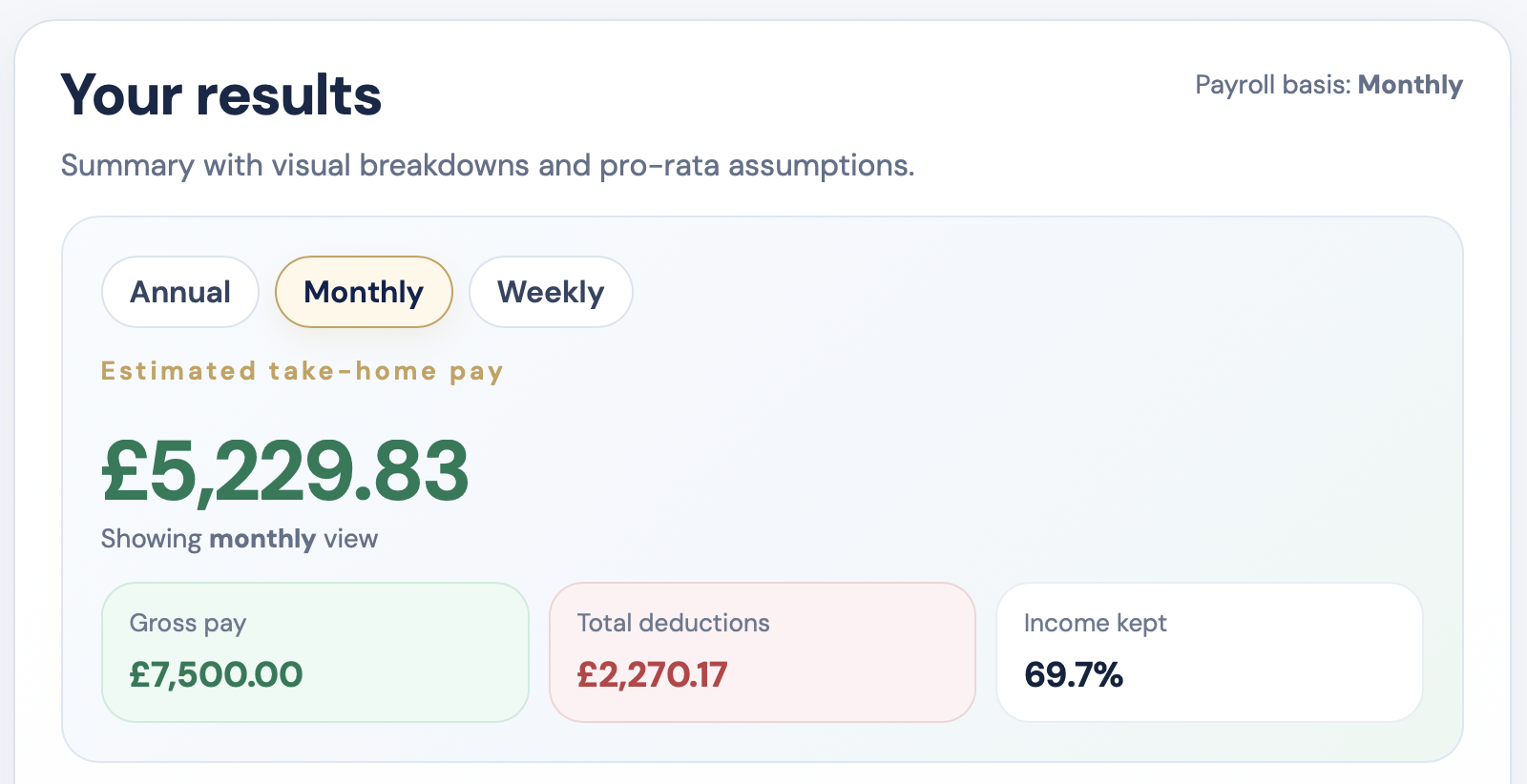
If you earn £90,000 a year, your monthly take-home pay in the UK in 2026 is roughly £5,229.83 after Income Tax and employee National Insurance, assuming you are on a standard tax code, have no pension salary sacrifice, and do not live in Scotland.
This means:
- Annual take-home pay: £62,757.96
- Monthly take-home pay: £5,229.83
- Weekly take-home pay: ~£1,207
This guide explains exactly how your £90,000 salary is taxed, how much you take home each month, and what factors can change your net pay.
This calculation is based on the 2026/27 UK tax year using the figures provided here.
If you want to test your own payslip with pension, bonus or student loan deductions, use our take home pay calculator for a personalised result.
£90,000 take-home pay UK (2026 summary)
- Gross salary: £90,000
- 20% Income Tax: £7,539.96
- 40% Income Tax: £15,891.96
- National Insurance: £3,810.00
- Net annual pay: £62,757.96
- Net monthly pay: £5,229.83
- Net weekly pay: ~£1,207
£90,000 salary after tax in the UK: monthly and annual breakdown
| Item | Annual | Monthly |
|---|---|---|
| Gross salary | £90,000.00 | £7,500.00 |
| 20% Income Tax | £7,539.96 | £628.33 |
| 40% Income Tax | £15,891.96 | £1,324.33 |
| Employee National Insurance | £3,810.00 | £317.50 |
| Take-home pay | £62,757.96 | £5,229.83 |
So for most employees in England, Wales and Northern Ireland, £90k after tax is about £5.2k per month.
£90,000 weekly take-home pay UK
If you earn £90,000 per year, your weekly take-home pay is approximately £1,207 after tax and National Insurance.
This is useful for:
- Weekly budgeting and cash flow planning
- Comparing senior salaried roles with contract work
- Understanding how much of your gross income you actually keep
How the tax is worked out
For the 2026 to 2027 tax year, the standard Personal Allowance is £12,570. The basic rate of Income Tax is 20% up to £50,270, and income above that threshold is generally taxed at 40% for most UK taxpayers outside Scotland. Employee National Insurance is generally charged at 8% and then 2% above the upper earnings limit.
On a £90,000 salary:
- The first £12,570 is tax-free
- A portion is taxed at 20% = £7,539.96
- A much larger portion is taxed at 40% = £15,891.96
- Employee National Insurance totals about £3,810.00
At £90,000, a large share of your earnings is already in the 40% tax band. This means pay rises and bonuses can feel much less valuable in net terms than they do on paper.
What is £90k per month before and after tax?
Before deductions, a £90,000 salary is £7,500.00 per month.
After Income Tax and National Insurance, that falls to around £5,229.83 per month.
- Gross monthly pay: £7,500.00
- Total monthly tax and NI: £2,270.16
- Net monthly pay: £5,229.83
How to manage the 40% tax band on £90,000
At £90,000, higher-rate tax is now a major part of your payslip. Managing your salary efficiently becomes more important because each extra £1 of income above the higher-rate threshold is taxed much more heavily than income in the basic-rate band.
Common strategies people consider at this level include:
- Increasing workplace pension contributions
- Using salary sacrifice where available
- Reviewing how bonuses are paid and timed
- Checking the combined impact of tax, National Insurance and student loan deductions
- Planning ahead for the £100,000 Personal Allowance taper
That final point matters more at £90,000 than at lower salary levels. You are still below £100,000, so your full Personal Allowance is typically still available. But if your salary increases further, or if you receive a large bonus, you may move into the range where your Personal Allowance starts to be withdrawn. That can make the effective tax cost of extra income much steeper.
Because of that, £90k is often a useful point to think ahead rather than waiting until you are already over £100k. Pension planning, bonus timing and salary sacrifice can become more valuable as you get closer to that threshold.
Can a SIPP help if you earn £90,000?
Yes, a SIPP (Self-Invested Personal Pension) can be a useful option if you earn £90,000 and want more control over tax planning and long-term investing.
A SIPP lets you make extra pension contributions outside your workplace pension, often with a wider choice of funds and investments. At this salary level, it can be a practical way to reduce higher-rate taxable income while building retirement savings.
At £90,000, a SIPP may help you:
- Reduce income exposed to higher-rate tax
- Claim additional higher-rate pension tax relief where eligible
- Prepare more efficiently for earnings approaching £100k
- Build long-term investments in a flexible pension wrapper
Many SIPPs use relief at source, where basic-rate tax relief is added automatically. If you are a higher-rate taxpayer, you may need to claim the extra relief separately through HMRC.
A SIPP is not always more efficient than salary sacrifice, because salary sacrifice can sometimes reduce both Income Tax and National Insurance. But a SIPP can still be a strong option if you want wider investment choice or want to make extra contributions outside your employer scheme.
If you want to model how pension contributions could affect your monthly net pay, use our take home pay calculator.
£90k salary after tax with student loan deductions
If you still repay a student loan, your real monthly take-home will be lower. The Income Tax and National Insurance figures do not change here, but student loan deductions reduce what actually lands in your bank account.
| Scenario | Annual take-home | Monthly take-home |
|---|---|---|
| No student loan | £62,757.96 | £5,229.83 |
| Plan 1 | £57,078.96 | £4,756.58 |
| Plan 2 | £57,302.64 | £4,775.22 |
| Plan 5 | £56,907.96 | £4,742.33 |
| Postgraduate Loan only | £58,617.96 | £4,884.83 |
The matching student loan deductions are:
- Plan 1: £5,679.00 per year or £473.25 per month
- Plan 2: £5,455.32 per year or £454.61 per month
- Plan 5: £5,850.00 per year or £487.50 per month
- Postgraduate Loan only: £4,140.00 per year or £345.00 per month
At this salary, a Plan 2 borrower loses roughly £454.61 per month, while a Plan 5 borrower loses about £487.50 per month.
You can estimate your repayments using our student loan calculator.
£90,000 vs £80,000 salary UK
Moving from £80,000 to £90,000 increases your gross pay, but a large share of the extra income is taxed at 40%. That means the rise in take-home pay is smaller than many people expect.
You can compare salary levels using our salary comparison calculator.
Monthly budgeting on a £90,000 salary
With a take-home of around £4,742 to £5,230 per month depending on deductions, many people can usually cover:
- Mortgage or rent payments
- Bills and utilities
- Transport and commuting
- Regular savings, investing and pension top-ups
- Discretionary spending and lifestyle costs
Even so, your actual financial comfort still depends heavily on housing costs, childcare, debt repayments and where you live. A £90k salary can feel strong in many parts of the UK, but fixed costs can still absorb a large share of monthly income.
What can reduce your £90k take-home pay further?
Your actual payslip may be lower if you have:
- Workplace pension contributions
- Salary sacrifice arrangements
- Student loan deductions
- Bonus payments taxed through PAYE
- Scottish Income Tax rates
To model your exact situation, use our take home pay calculator.
Is £90,000 a good salary in the UK?
In many parts of the UK, £90k is considered a very strong salary and well above average full-time earnings.
- Usually strong income in most regions
- Can support saving, investing and pension planning
- Still affected heavily by higher-rate tax and student loan deductions
What matters most is not just the headline salary, but how much of it you actually keep after tax and how efficiently you manage the part that falls into the higher-rate band.
What should you do next?
If you are earning £90,000, you may want to:
- Review whether pension contributions could improve tax efficiency
- Estimate the impact of student loan deductions on your monthly cash flow
- Plan ahead for earnings getting closer to £100,000
Useful tools:
Summary
A £90,000 salary after tax in the UK works out to about £62,757.96 per year or £5,229.83 per month in 2026 using the figures provided here.
Your real take-home may be closer to £4,742 to £4,885 per month if student loan deductions apply. At this level, planning around higher-rate tax, pension contributions, salary sacrifice, SIPPs and the approaching £100k threshold can make a meaningful difference to your finances.